



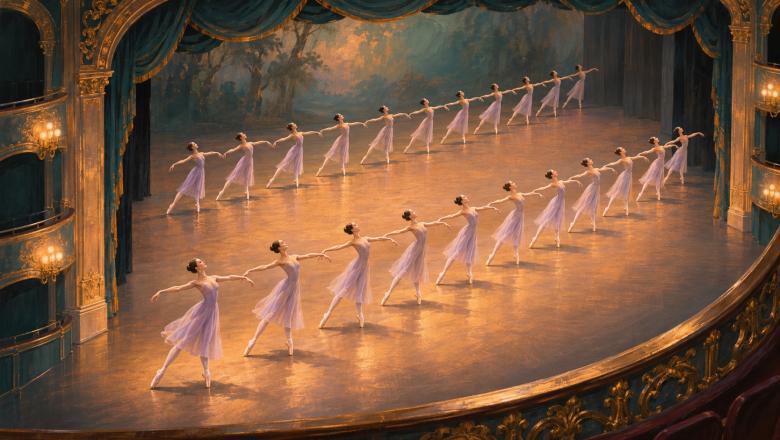

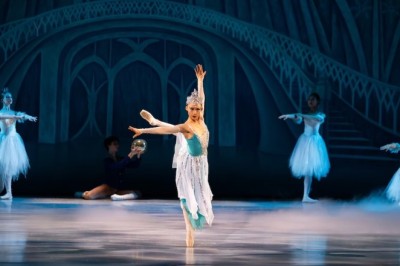
A ballerina steps forward. Behind her, a diagonal line of dancers stretches across the stage. As she begins to turn, the line opens, leaving a clear space around her. Your eye goes straight to the soloist. The dancers behind her helped send it there.
That’s one pleasure of watching the corps de ballet, the ensemble dancers in a ballet company. Their formations can frame a solo, make a crowded stage feel still, or draw your attention from one side of the theater to the other. Next time you watch a ballet, give the ensemble a few uninterrupted seconds. Here’s where to look.
Follow the line as it moves
Pick one formation and see what happens to it. A diagonal might become two parallel lines. A circle might open just long enough for a dancer to pass through. Watch the spaces between the dancers as they travel. Can you tell where the new shape is going before anyone arrives?
Then watch the dancers at the ends of the line. The person nearest the wing and the person nearest center stage may have different distances to cover before the next formation. If they arrive together on the music, the whole shape can appear in a single beat.
Listen for what the dancers share
Choose a musical detail you can hear clearly, like a recurring string phrase or a strong beat. Notice what the ensemble does each time it comes back. Perhaps everyone changes direction at once. Perhaps a gesture begins at one end of the stage and travels down the line, dancer by dancer.
Try watching the feet for one phrase and the upper body for the next. You may hear the steps land right on the beat while the arms continue moving through it. The choreography can give you two ways to hear the same music.
Look at the ensemble when it stands still
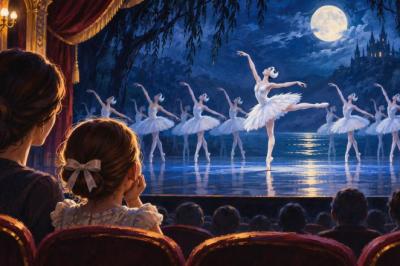
In a scene such as the lakeside act of Swan Lake, look at where the swans are facing while the principal dancers move. Even a held pose can direct attention. A row of dancers looking toward the same person makes that person the center of the scene before they take another step.
As the solo unfolds, glance back to the ensemble. Notice when the dancers shift their gaze or change the angle of their bodies. A small change across a whole group can be as visible as a big movement from one dancer.
Try it with a ballet you already know
On your first viewing of a scene, follow the lead dancer as you normally would. On the second, keep your eyes on the ensemble through the same passage. See when the dancers make room, close the space again, or carry the movement into the next phrase. You may find yourself waiting for a moment you barely noticed the first time.
What ensemble scene would you watch twice? Tell us which ballet it’s from and what you’d watch for the second time.


What's your reaction?
You may also like
-

What Makes the Sugar Plum Fairy Sound Like That?
-
How Two Young Choreographers Made the Prix de Lausanne 2027 Repertoire
-
Why a Ballet Waltz Feels Like It Floats
-
Can You Write Down a Ballet? Inside Benesh Movement Notation
-
When Ballet Meets Tap: Steven McRae's Mad Hatter Is a Must-Watch
-
Fonteyn 2026: Erin Alarie Wins Gold and a Prize for Creativity







Comments
0 comment